The Hamilton-Norwood Scale

For men, hair loss tends to follow a typical pattern. Yet, before James Hamilton came up with his 7-stage scale, there was no standardized way to measure or describe degrees of baldness. Thanks to him and to O'Tar Norwood, who revised the scale, improved it, in the 1970s, we now have a tool that is used to describe the stages of male pattern baldness.

Our specialists use this tool to understand the progression of a patient's hair loss and to determine a protocol for hair restoration. A person with stage 1-3 requires less intervention than does someone in a later stage. This is why it's good to come in before your hair loss becomes advanced.

Stages of
Baldness in Men

Stage 1:

This stage marks the lightest hair loss with thinning at the temples that often goes unnoticed or is ignored. 

Stage 2:

In a close continuation of stage 1, the balding near the temples moves inward, creating that M-shaped hairline you see in men who are just beginning to lose their hair. 

> Stage 3
< Back

Stage 3:

The temple recession continues until there’s little to no hair in the temporal regions (at the temples). It is at this stage that the hair on the top of the head becomes thinner with bald spots starting to appear. 

Stage 4:

At this point, there’s no denying that you’re experiencing male-pattern baldness. You develop noticeable bald spots. The hair on the crown of your head thins and you may lose large patches of hair at the back of your head at the vertex or on the front of your head. 

The Ludwig Scale

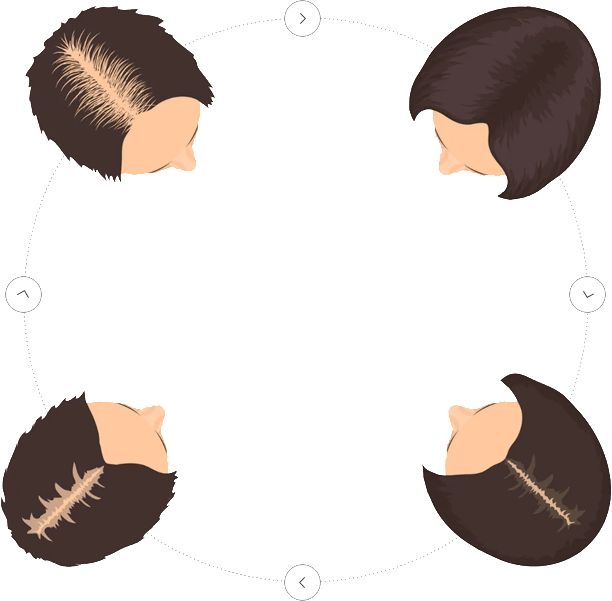
Female hair loss is a bit more complicated. It tends to follow less of a pattern and often manifests as a general thinning and without the hairline recession that men experience. Yet, the Ludwig scale was developed to describe the severity of a woman’s hair loss. It includes 3 grades 1 – 3 and is based on how much of the scalp is visible from the front due to thinning hair.

See The Results For Yourself

Disclaimer: Results and patient experience may vary. These are dependent on a number of factors such as age, medical history and lifestyle.

Hair Loss FAQ’s

I'm at Stage 4. Is there still time for a hair transplant?+
There is still time! It’s around stage 5 that hair restoration becomes much more difficult. So much depends on the quality and quantity of the hair on your donor area (the back of your head.)
How can I slow my hair loss?+
Are all hair transplants basically the same?+
What our patients say about Lutetia’s DHI hair transplant

Having always been careful with my beard, I have long wanted to make implants so that it is designed and supplied... I was told about this method... I went to get information, and the professionalism of the staff, the doctors and the structure of the clinic convinced me to take the plunge.

Raphael Lellouche
Beard Transplant

Beautiful clinic, hospitality and impeccable professionalism... at one month the donor area is impossible to suspect a transplant. So if you are looking for the best it is France, Paris Clinic DHI Lutétia.

Broderie Sequin
Hair Transplant

Interested in learning more about our advanced transplant?
Speak to a DHI expert today.

Let one of our DHI experts talk you through your options and discuss our bespoke treatment packages for your unique needs.